
The twelve pillars
Each pillar is a question a board, a customer or a regulator will eventually ask. A system is assured when you can answer all twelve with evidence, and keep answering them as it changes.
-
Evaluation (opens in a new tab)
Is our AI actually doing what we need it to do?
-
Observability and monitoring (opens in a new tab)
Would we know if it started going wrong today?
-
Explainability (opens in a new tab)
Can we explain why it gave that answer?
-
Guardrails and safety control (opens in a new tab)
What stops it doing something harmful or off-brand?
-
Data privacy (opens in a new tab)
Is personal data handled lawfully at every step?
-
Human involvement (opens in a new tab)
Where do people stay in control?
-
Governance, accountability and compliance (opens in a new tab)
Who owns this AI, and can we prove we comply?
-
Cost performance, operational efficiency and scalability (opens in a new tab)
Will it stay affordable and fast as usage grows?
-
Resilience (opens in a new tab)
What happens when a model or provider fails?
-
Security (opens in a new tab)
Could someone attack or misuse it?
-
Testing (opens in a new tab)
How do we know a change will not break it?
-
Ethics and bias (opens in a new tab)
Is it fair to everyone it affects?
Read the full framework at twelvepillars.ai (opens in a new tab)
Start small, go as far as you need
-
2 weeks
AI Assurance Check
A fixed-price first look at one AI system, with a rating for each pillar and a 90-day action plan.
-
2–8 weeks
Assessment
An independent assessment of your AI applications against all twelve pillars, with a gap analysis and a prioritised plan for leadership.
-
1 day – 12 weeks
Training
Executive briefings, practitioner workshops and longer programmes, using your own AI use cases, from the author of the framework.
-
3–9 months
Implementation
We put assurance in place across your AI systems, from governance and inventory to evaluation, monitoring and guardrails, then hand it over.
What the two-week Check gives you
A kick-off workshop, a review of what already exists and up to four short interviews. Then a written report: a rating for each of the twelve pillars, the five biggest risks in plain English, and an action plan in priority order, presented to your leadership.
Findings are mapped to the rules that apply to you, including the EU AI Act, UK GDPR, ISO/IEC 42001 and the NIST AI Risk Management Framework. Read-only access to your systems helps, and where access is restricted we work from documentation, demonstrations and interviews.
- 01EvaluationStrong
- 02ObservabilityGap
- 03ExplainabilityAdequate
- 04GuardrailsAdequate
- 05Data privacyStrong
- 06Human involvementAdequate
- 07GovernanceStrong
- 08Cost & scaleAdequate
- 09ResilienceGap
- 10SecurityStrong
- 11TestingGap
- 12Ethics & biasAdequate
Illustrative ratings, to show the format of the report.
Written from delivery, in government and enterprise
The framework came out of doing this work for real. We have delivered AI assurance for the Crown Prosecution Service and the Cabinet Office, including leading the design and delivery of a national AI assurance framework: real-time monitoring, ethical oversight and auditability for AI systems used by thousands of staff.
The same discipline took an HR AI system for a global bank from pilot to production with Microsoft, where it saved managers an estimated 110,000 hours in its first year. Twelve Pillars also takes in Signet, our earlier AI assurance assessment.
“AI safety and assurance does not slow us down. It removes blind spots which allow us to run faster and with more confidence.”
The book · coming soon
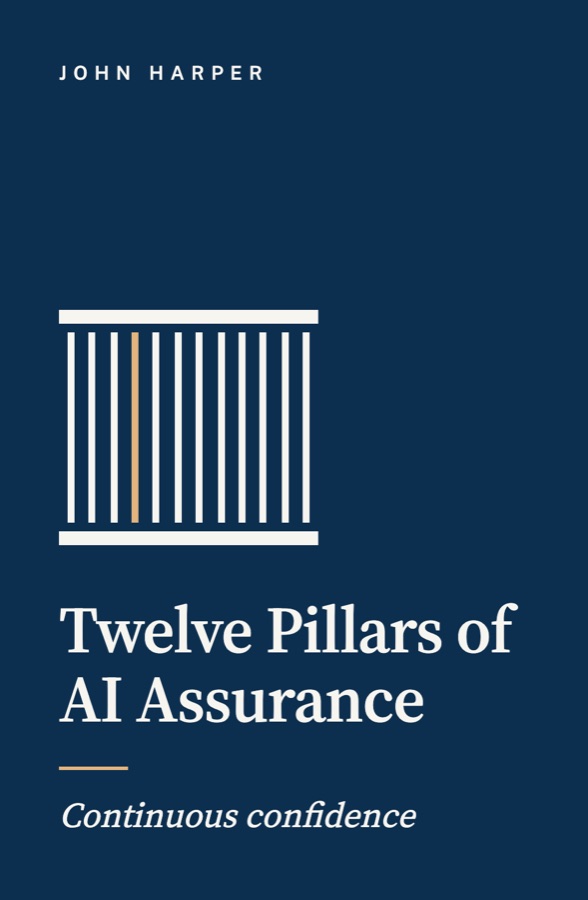
Twelve Pillars of AI Assurance: Continuous Confidence
A practical field guide by John Harper for the engineers and technical leads taking generative AI from prototype into production. It sets out the twelve pillars, what good looks like for each, and how to keep confidence continuous as systems change.
Questions about AI assurance
- What is AI assurance?
- AI assurance is the work of showing, with evidence, that an AI system does what it is meant to do, safely and lawfully, and keeps doing so as it changes. It covers how the system is evaluated, monitored, secured, governed and overseen by people.
- What are the Twelve Pillars of AI assurance?
- Evaluation; observability and monitoring; explainability; guardrails and safety control; data privacy; human involvement; governance, accountability and compliance; cost performance, operational efficiency and scalability; resilience; security; testing; and ethics and bias. The framework was created by John Harper of Cambridge Machine Learning.
- How long does an AI assurance assessment take?
- The AI Assurance Check takes two weeks for one AI system. A full assessment takes two to eight weeks, depending on how many systems are in scope and how complex they are.
- Does it cover the EU AI Act?
- Yes. Findings are mapped to the rules that apply to you, including the EU AI Act, UK GDPR, ISO/IEC 42001 and the NIST AI Risk Management Framework. An assessment is independent evidence of where you stand. It is not legal advice or a certification.
- Do you need access to our systems?
- Read-only access helps, but we can work from documentation, demonstrations and interviews where access is restricted.
- What happens after an assessment?
- You keep the report and the action plan. Many clients follow with training or implementation, but there is no obligation.
Build with confidence
From strategy to delivery, we help teams ship reliable, production-ready AI, with clear assurance and governance where it matters.
Want to know where your AI stands?
A 30-minute call is enough to tell you which pillars matter most for your system and where we would start.